
IGF1 LR3 vs HGH – Which Growth Hormone Works Better?

As long as you read about performance, anti-aging, or body recomposition, two names are just repeated over and over again, and these are: IGF-1 LR3 and HGH. They both are associated with muscle gain, fat loss and recovery, and are both at the same growth-hormone axis. Still, they act at different points in that system, and they feel different in practice.
In simple terms, the IGF-1 LR3 vs HGH comparison is a question of “where” you intervene:
- HGH (human growth hormone) sits near the top. It’s the master hormone that tells the body when to grow, repair, and burn fat.
- IGF-1 LR3 works further down the chain, closer to the muscle and other tissues that actually change in response to training.
There are individuals who would only be interested in one of them. Other people consider an IGF-1 LR3 and HGH cycle and wish to have a broad background push of growth hormone and a more punched local shove of IGF-1. To get to the bottom of why, it is better to look at each of them individually and then compare them.
What Is IGF-1 LR3? Mechanism, Benefits, and Muscle Growth
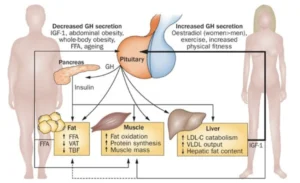
IGF-1 (insulin-like growth factor 1) is among the primary messengers that are activated by growth hormone. In an ideal scenario, the release of growth hormone by the pituitary gland is reciprocated by the liver, which produces IGF-1 to be used by muscles in growing, recovering, and repairing tissues.

This molecule has been modified as IGF-1 LR3. The small modification LR3 (long arginine 3) is what keeps it active in the body significantly longer than normal IGF-1. It also stimulates its receptors in muscle and other tissues directly instead of stimulating the production of natural growth hormone.
And should you reduce it to the essence:
- IGF-1 LR3 is prepared in the laboratory, and it lasts for hours instead of minutes.
- It talks directly to cells that can grow and divide, especially in muscle.
- It bypasses the step where growth hormone has to trigger the liver first.
Within the IGF-1 LR3 vs. HGH debate, that makes IGF-1 LR3 more of a specialist. Growth hormone gives a general signal; IGF-1 LR3 works closer to the “ground level” where muscle thickness, cell number, and recovery are decided.
Key Benefits of IGF-1 LR3 for Athletes
People who look at IGF-1 LR3 tend to care about very concrete training outcomes.
- More muscle over time.
IGF-1 LR3 is associated with increases in cell number (hyperplasia) and with stronger protein synthesis. For lifters who already train hard and eat enough, that can translate into more size and shape in the muscles they push the hardest. - Less time to get back on the feet. IGF-1 LR3 has the potential to reduce the time to recover between exercise sessions by enhancing nutrient delivery and repair signaling. That allows higher training volume without feeling ground down all the time.
- A leaner visual effect.
Compared with some hormones that cause obvious water retention, IGF-1 LR3 is often used in phases where a “dry” look is preferred. Muscles can look fuller without as much extra fluid under the skin.
Meanwhile, the IGF-1 LR3 is located in a sensitive area within the system. Pushing it too hard, too long, or in the wrong context changes how the body handles glucose and where new tissue might grow.
What Is HGH? How Human Growth Hormone Works in the Body
The amount of growth hormone is made in the pituitary gland and discharged in brief pulses, particularly at night. It controls height in childhood, although it is important as you get older in life, for metabolism, repairing tissue, body composition, and how you feel in your daily life.
When individuals refer to HGH, they refer to synthetic human growth hormone. It closely copies the hormone the body makes on its own. Once it is in the bloodstream, several things happen:
- IGF-1 is produced more by the liver and other tissues.
- There is a change in fuel consumption whereby an individual burns more fat and retains lean tissue.
- There is a modification in water equilibrium and connective tissue turnover, which is experienced by many lifters in their joints and skin.
In that sense, HGH acts like a broad conductor. It sets the overall tone, while IGF-1 carries out much of the detailed work underneath.
You’ll also hear about igf1 lr3 vs hgh approach. Those are brief chains of amino-acids, which make the pituitary release additional of its own growth hormone rather than injecting the hormone. Both roads end up on the same axis, but at slightly different doors.
Main Benefits of HGH for Bodybuilding
When people list HGH benefits for physique goals, a few points come up again and again:
- Support for lean mass.
Together with rigorous training and sufficient protein, this forms a more favorable condition of consistent hypertrophy of muscles than the random increase of weight. - Better recovery and sleep.
Numerous users have noted enhanced sleep, faster recuperation of strenuous exercises, with enhanced growth-hormone signaling. That will be the only thing that can alter the frequency and intensity with which one can train. - HGH for fat loss.
The growth hormone favors fat as a source of energy. It does not substitute a deficit of calories, but it may be used to maintain more muscle, as the body fat gradually decreases, especially around the waist. - HGH for anti-aging.
The men and women discuss the improvement of their skin, hair, and somewhat increased motivation in their everyday lives.
IGF1 LR3 vs HGH – Comparing Muscle Growth and Fat Loss
Once both compounds are clear, the direct comparison becomes easier. The igf1 lr3 vs hgh question splits into a few practical parts: muscle gain, fat loss, and overall feel.
For muscle growth, the picture looks like this:
- HGH works as a foundation. It promotes gradual recovery by stabilizing IGF-1, enhancing recovery, and aiding the body to utilize the nutrients more efficiently. That background can change a lot in the course of many months.
- IGF-1 LR3 is more like a spotlight. It increases the signal at certain tissues and training phases, often with the goal of bringing up weak points or getting more out of a hard block of programming.

For fat loss, HGH usually has a stronger direct influence:
- HGH for fat loss is well known. An increase in the activity of the growth hormone will prefer fat as a source of energy and may increase the ease of remaining lean whilst eating slightly above maintenance or reducing at a very slow pace.
- IGF-1 LR3 helps more indirectly by protecting lean tissue and allowing higher training intensity during a diet.
Recovery sits in the middle. IGF-I LR3 and HGH both can make you feel prepared for the next session, albeit with differing focuses: HGH by improving sleep and overall rejuvenation, and IGF-I LR3 by making you sharper with your muscles.
IGF-1 LR3 vs HGH – Which Is Better for Cutting?
Most lifters are concerned with three things during a cut: preserving as much muscle as they can, losing fat without being made to feel miserable, and remaining presentable in the mirror.
HGH tends to fit that picture quite well:
- It helps maintain lean mass when calories drop.
- It supports a slightly higher metabolic rate and more stable energy.
- It overlaps with some HGH for anti-aging effects, which matters when the diet gets long and motivation dips.
IGF-1 LR3 can still be useful during cutting, but in a different way:
- It can help muscles stay full and dense even when glycogen is not always topped up.
- It supports training output and joint comfort, which are easy to lose in a deep deficit.
Which lens would you prefer: HGH is typically the better helper in fat-loss support, where IGF-1 LR3 is more about the quality and performance of muscle, with a drop in the scale.
IGF-1 LR3 vs HGH – Which Is Better for Bulking?
Bulking flips the question. Now the focus is on adding size without turning the mirror into a shock every few weeks. Here, the contrast between igf1 lr3 vs hgh shows up again:
- IGF-1 LR3 is often seen as the sharper mass-gain tool. People use it when they want an assertive push in specific muscle groups. It tends to be associated with quicker visual changes and that “full” look many bodybuilders chase.
- HGH is slower but more rounded. It leans toward better tendon and joint comfort, steady lean mass gain, and a healthier ratio between new muscle and new fat over a long surplus.
Because both compounds act on the same general growth pathway, this is also where restraint matters. Strong signals can backfire if IGF-1 LR3 dosage is pushed without a plan, or if growth hormone is kept high for long stretches without monitoring. That is where the line between a good bulk and a messy one is often drawn.
IGF-1 LR3 and HGH Cycle – How to Combine Them Safely
A common meaning of a setup in which HGH is running as a base, and IGF-1 LR3 is overlaid on it during specific intervals, would be to refer to an IGF-1 LR3 and HGH cycle.
This notion has an approximate appearance as follows:
- Synthetic human growth hormone shapes the general environment: better repair, gradual body-recomposition, and a more supportive setting for muscle gain and fat management.
- IGF-1 LR3 is introduced during blocks where extra IGF-1 for muscle growth is desired, often matching heavy training phases or preparation for a certain look.
Rather than expecting one compound to do everything, this approach splits the work:
- HGH acts as the steady background signal.
- IGF-1 LR3 provides brief, focused bursts when more growth or recovery in specific areas is the priority.
Various individuals test with various schedules, yet the general concept remains the same, the combination is intended to operate each material in the area where it performs best, rather than operating both flat-out at all times.
Should You Use IGF-1 LR3 and HGH Together?
From a purely theoretical point of view, pairing IGF-1 LR3 with HGH has clear synergy:
- Growth hormone raises overall capacity for growth and repair.
- IGF-1 LR3 then takes advantage of that capacity by sending more intense signals at the tissue level.
At the same time, stacking both also multiplies the load on systems that control blood sugar, tissue growth and fluid balance. The effects do not just add; they can amplify each other in ways that are hard to predict.
Side Effects: IGF1 LR3 vs HGH Safety Comparison
No honest igf1 lr3 vs hgh overview can ignore side effects. Both substances sit on a pathway the body normally controls very tightly, and pushing that system always has a price.
For IGF-1 LR3, concerns often center on:
- Blood sugar control.
Good signaling of IGF-1 can stimulate the rapid entry of glucose into cells. When the timing or balance of food is inaccurate, it may result in low blood sugar spikes and the well-known shaky, sweaty sensation. - Unwanted tissue growth.
IGF-1 does not know which growth you actually want. If exposure is too frequent or too long, questions arise about what else might enlarge besides muscles. - Numbness and odd sensations.
Some users describe tingling, strange pumps or discomfort in certain areas when IGF-1 LR3 is pushed too hard. These can be early warnings that the signal is too loud.
Those points sit under the broader idea of IGF-1 side effects. They are tied directly to how the molecule works, not just to “bad luck.”
With HGH, the pattern is different:
- Water retention and puffiness.
Swollen fingers, a rounder face or tight shoes can all show up when growth hormone is high for a while. - Joint and nerve discomfort.
Fluid shifts around joints and nerves can lead to pain or numbness, including classic carpal tunnel syndrome symptoms in the wrists. - Insulin sensitivity changes.
Long exposure to elevated growth hormone can make the body react differently to carbohydrates, which may push fasting glucose and insulin in the wrong direction.
Here, too, these are not random problems; they flow directly from how growth hormone influences metabolism and tissues. Both IGF-1 LR3 and HGH can be effective, yet they may also cause significant damage when handled carelessly.
IGF1 LR3 vs HGH – Which One Should You Choose? Final Thoughts
All add it up, it’s not about who wins and loses in igf1 lr3 vs hgh, but whether to use the right tools to achieve specific goals, budget, and risk tolerance.
- HGH serves as a wide foundation: consistent HGH gains in recovery, body structure, HGH in slimming assistance and a small portion of HGH in anti-aging purposes. It is slower, more global, and usually more expensive, but it reshapes the whole system over time.
- IGF-1 LR3 is the sharp instrument: strong, direct IGF-1 for muscle growth, faster visible changes and more control over where effort in the gym shows up. It also demands more respect around dosing, duration, and context.
Some use HGH as the base and IGF-1 LR3 as an amplifier at key stages. Others make it easier and rest on a single side of the axis and put the majority of their efforts in training, eating, sleeping, and patience.
In any case, both compounds are placed in the same potent hormonal system. Knowing the actions of each of them, their primary advantages and the point at which the dangers begin is the initial step before even having a more serious conversation on the usage of IGF-1 LR3, HGH or a combination of the two.